Mar 31, 2011

Life is So Good and Books as Lenses

Our town and a neighboring town have a committee of librarians other individuals who choose a theme and a book to fit that theme each year. It's kind of like having a town-wide book club with events throughout the year.  I was excited to be more on the ball with this for 2010-2011 and really feel like a participant. 

image source

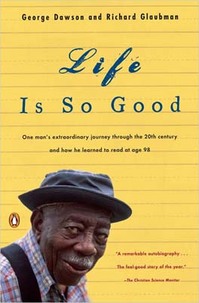
This year's theme was What makes life worth living? and the committee decided on the book Life is So Good: One Man's Extraordinary Journey Through the 20th Century and How He Learned to Read at Age 98 by George Dawson and Richard Glaubman to represent the theme.  I signed up to lead a book group discussion for my women's book group in May and the genre was for a biography. I knew our library would have tons of copies of this book so I chose this one after I started reading the first few chapters last November.  
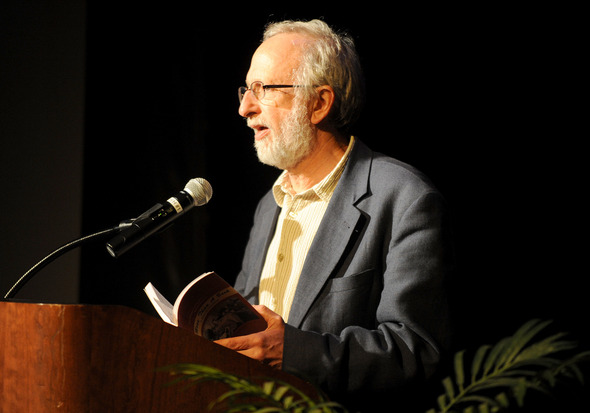
Richard Glaubman
image source
Mr. Dawson died in 2001 at the tender age of 103, but I got to hear Richard Glaubman speak in January when he came to a function sponsored by the committee here.  After I read his life story, I felt that Mr. Dawson was a cherished friend of mine. I found this book to be very riveting and inspiring. It made me want to have better relationships, to simply love people, to stop judging people, to forget myself, and it made me want to learn more and to work much, much harder. 

While I could write a gushing review about this book and encourage everyone to read it (please read it!), I wanted to bring this Look at Books with Team Hoopes series to a close by simply saying that it is often the seemingly simple books we read that have the greatest effect on us and how we view the everyday. 

When we read we get a chance to see the world through a different lens, and if we allow it to persist long after we've finished another book, that lens can remain important to us and perhaps even necessary - it might color the world through our eyes a little more brightly, and it might bring different things into focus that we hadn't thought to pay as close attention to before. Each book that we read gives us another lens. We might add it to our frames today, hold it in a safe pocket until we need it most, or just keep it close to our heart. And none of us will ever have the same lens prescription needs, but these are lenses that can be swapped and shared and passed around.   

Thanks for sharing, learning, and Look-at-Books-ing with me this month!  It has been a wonderful chance to exercise my brain, to learn so many new things and to renew my dedication to instilling in my children a love for learning and reading. Happy Reading! 


Giveaway winner will be announced tomorrow on April Fools Day (no joke!). So enter, quick! 

Mar 30, 2011

The Reading Mother, by Strickland Gillilan

Sometimes when I am reading a book to my kids (and there are other good things that probably need doing at the same moment) I think of this poem and it reminds me that it is okay to keep reading. Adults and kids, grandparents and grandchildren, older sibling and younger sibling, dads and daughters, moms and sons, uncles and nieces...when big people and little people share books with each other, great things happen!

The poet uses mother and boy throughout this poem, but put yourself in the verse somehow to make it more meaningful.


I had a mother who read to me

Sagas of pirates who scoured the sea.
Cutlasses clenched in their yellow teeth;
"Blackbirds" stowed in the hold beneath.
I had a Mother who read me lays
Of ancient and gallant and golden days;
Stories of Marmion and Ivanhoe,
Which every boy has a right to know.
I had a Mother who read me tales
Of Gelert the hound of the hills of Wales,
True to his trust till his tragic death,
Faithfulness lent with his final breath.
I had a Mother who read me the things
That wholesome life to the boy heart brings-
Stories that stir with an upward touch.
Oh, that each mother of boys were such!
You may have tangible wealth untold;
Caskets of jewels and coffers of gold.
Richer than I you can never be --
I had a Mother who read to me.


(Strickland Gillilan)

Mar 29, 2011

Jim Trelease: Advocate of Reading Aloud

I first came across the name of Jim Trelease when I emailed a religion professor at BYU, Dennis Wright, to ask about his book Scripture Power. I am grateful to Dr. Wright for sharing with me that he based his developmentally appropriate practices in Scripture Power on what Trelease outlines in The Read-Aloud Handbook (TRAH). 

image source


TRAH was first published in 1982 and Trelease has since spoken all over the country & in other countries as well talking about the unmatched benefits of reading aloud to children.  TRAH has a nice, long list of books that are great read-aloud selections for kids of various ages. Jim Trelease was simply a dad who read to his two daughters, and a newspaperman who visited school classrooms on a regular basis. From his website
Thinking there might be a connection between being read to and how much the child wanted to read, Jim investigated to see if any research was available on the subject. Sure enough, there was lots of it— but nearly always published in education journals or written in academic language that would be foreign to the average parent or teacher.
The dearth of accessible material inspired him to write and self-publish the first edition of The Read-Aloud Handbook in 1979. "I self-published because I never thought any of the major publishers would be interested in it. At that point, 'reading aloud' was too simple and not painful enough to do the child any good. At least, that's what many educators thought," he says in hindsight. But that mindset would soon change.
Discovered accidentally by a then-fledgling literary agent named Raphael Sagalyn, the book came to the attention of Penguin USA after six other publishers turned it down. In 1982, they published an expanded edition. Touted by "Dear Abby" in February of 1983, it spent 17 weeks onThe New York Times bestseller list. (Covers and details of all U.S. and international editions can be found at Read-Aloud covers.)
By 1985, the U.S. Department of Education's Commission on Reading was calling "reading aloud to children" the single most important activity one could do to raise a reader.

Here are a few basic ideas from TRAH:

  • Read to your child from day one.
  • Keep reading to your child until he’s a teenager.
  • Make yours a print-rich home, with books, magazines, and newspapers in every room.
  • Buy your older child a book-light to stay up late reading, and say yes to one more book request from  your younger child. (But, to keep eyes healthy, kids shouldn't fall asleep with lights on in their rooms!)
  • Set a good example by being an active reader yourself.
I also own one of Trelease's other books, Hey! Listen to This: Stories to Read AloudThis one has excerpts from many classic children's tales - short teasers that get kids (or adults) listening to a great story and maybe interested in reading the book the excerpt came from.  Read All About It is Trelease's similar collection, but aimed at 5th graders to pre-teens. Take a look at Trelease's website to find author bios, book reviews, essays about reading to children, and many other great ideas that he shares. My favorite idea on there (which is also in TRAH, and is something I plan to implement when I am not a renter in a home with few walls) is the rain gutter bookshelves

If your library has The Read-Aloud Handbook, in any of its editions (Korean, Mandarin...), but particularly the one pictured above, I recommend picking it up. It is an easily-read, research-based book that will make you want to keep reading to your kids. And if I haven't communicated the importance of that well enough this month, Jim Trelease can pick up my slack!!

Mar 28, 2011

Reading website/blog recommendations

I haven't had time to peruse all of these in depth, but I wanted to share a few websites tonight that have information about reading that could be of worth to some of you.

Preschool Book Club

Jim Trelease (the renowned Champion of reading aloud to kids! Look for a post about him & his books tomorrow!)

Reading Rockets (author interviews, loads of great articles)

Reading Recovery, mentioned in a post earlier this month by Michelle

Learning to read resources from Se7en

We Give Books - For each book read online through their site, a book is donated to a charity.  Read about How it Works.


Thanks to Sara for sharing some of her finds that I added to this list! Please add any suggestions to the comments section!  

Rebecca's birthday!

Last week Rebecca turned two. It was a very fun day to celebrate with her, and my parents and sister made the trip from Virginia to join us. We had a great time together and did all sorts of fun things.  As you can tell, Jeff was the CPT of the weekend (chief picture taker).

One sea turtle cake. It looked better in person, I promise.

Two one way rides on the bus.

Three levels of seating in the Hill Auditorium during my rehearsal.  Erin is trying to point me out to Jacob in the sea of singers on stage. 

Four hundred million LEGO in one room at the 2011 Brick Bash.

Five hundred million?

Okay I can't keep up the numbers anymore...
Making pretzel snakes with grandma!

Something was funny, but I have to focus on my pretzel building, so I shall stifle my laughter!

Something was VERY funny. No stifling necessary.

Ha! Birthdays crack me up.

Pippi Longstocking hair!

I love being two!

And this is just a nice picture. 

We are so lucky that Rebecca is in our family. Her whole life people have commented on how happy she is - and it really is true. Her smile lights up my life and she just makes the world a better place. I'm excited for all that she'll do in the coming years!  Happy 2nd Birthday, Rebecca Lea!


Mar 27, 2011

Spiritual Literacy Sunday: Reading scriptures with children

So this post will be a simple one, just to share what we do as far as reading scriptures with our children (and what we do may or may not "work" for us, I guess it depends on the day!). Please leave your suggestions in the comments. Have you found anything that works well for your family, or was there something your parents did when you were growing up that you could share?
  • We currently read one column from the Book of Mormon to our children each night before bed. It is part of our bedtime routine. There have been times when Jacob's reminded us to read when we've done things out of order, and Rebecca will bring the scriptures to me or Jeff when we are ready to read. I love that they know it is something to look forward to. 
  • It is important for children to hear the language of the scriptures in their own voice, even if they can't read yet. I don't do it as often as I'd like to (let's face it, sometimes we are in a hurry), but it is great for Jacob to be able to help me read. Jeff or I will read a phrase; Jacob repeats it back. 
  • Paraphrasing verses after you read them is a great way to get in the habit of really helping kids understand what you are reading.
  • If you have a child named Jacob, he will request almost nightly that you read his name while you are reading scriptures. Sometimes I throw it in randomly just to see that he is listening, but it is nice how often it just shows up. :)  


Other things we've done:

  • We have read a book mentioned in Gordon B. Hinckley's biography (because his mother read it with him when he was a boy) called Mother Stories from the Book of Mormon. The language is a little funny in some parts, just because it is older, but it makes the scriptures into more of a bedtime story. And we all know that kids like stories!
  • We've gone through many (I'd say nearly all) of the pictures in the Gospel Art Picture Kit and the new Gospel Art Book during a post-lunch/pre-naptime routine that we called Picture Time. During dinner Jacob would talk about what he learned for Picture Time with Jeff. It worked really well last summer and fall when Jacob was more consistently napping; this is something I would like to be more diligent about now - maybe during breakfast? Picture Time was a huge success, and gave me practice in summarizing scripture stories for a toddler and a preschool-aged child.
  • Reading the scripture stories books is also something my children have enjoyed. Have you listened to the Scripture Stories radio channel before?  Children can read along in your book with the children on the program.
There are so many ways to introduce young children to the scriptures, and I think as we find ways to keep it interesting and important, our children will have a greater desire to read the Bible or Book of Mormon or modern-day revelation on their own when they are able. Nothing can replace the actual scriptures, of course, and I believe this is key. To borrow a paragraph from the introductory pages of the Scripture Stories books:

This book will help you teach the scriptures. Share your testimony of the Book of Mormon [or Bible], and encourage those you teach to seek their own testimonies. Their understanding will grow as you read them the full text of their favorite stories from the Book of Mormon [or Bible] itself.

I don't want to sound like I'm ending a Church talk or something, but I sincerely hope that we can expose our children to the scriptures themselves in such a way that works for them, is developmentally appropriate, and that allows them to enlarge their understanding of the Lord's word and how it can apply to their lives today.

Please take a moment to share your suggestions!


PS Did you enter the giveaway?  I'll choose a winner on April 1st.  Odds are looking pretty good so far! :)  

Mar 26, 2011

Sharing What We Read

image source

Has anyone else read Blink, by Malcolm Gladwell? Blink was a book I'd heard of in my qualitative evaluation class in grad school and that I put on my birthday suggestions list later on that year. I got it from Jeff as a gift and read it in a couple of days while using blessed public transportation to get to work outside Washington, D.C. 

I bring up this book to illustrate this point: we weren't reading Blink as part of our coursework, but our professor shared some of the book with us because it fit in well with our discussion about evaluation. The key word here is that he shared. Since reading Blink I've also read The Tipping Point and Outliers, all by Gladwell. I do not think I would have been as compelled to read any of these three books without my professor's recommendation of Blink based on how it related to my evaluation course. They have been terribly popular books, to be sure, but I do not only read books because they are popular (off-topic: I've still never read anything from the vampire romance genre). A good discussion sharing what we've recently read goes a long way, even if the discussion doesn't involve a recommendation. This is not to say that I love everything about Gladwell's books. Even with all his examples I wasn't sure I totally agreed with his theses in each book. And that's fine. I can't recall how glowing of a recommendation my professor gave for Blink, but I appreciated that he took the time to have a discussion with our class about something he found interesting and which was not required reading. It piqued my interest, and I sought to read the same book. This is only one example of when I have followed through on reading a book after someone talked with me about it.

In response to a shameless mass e-mail I sent out begging asking for guest posts for this little blog series, I received this note from my graduate committee chair, Dr. David Williams. I had wanted to write something about this very subject but wasn't sure how I would approach it. I got his e-mail last week and he hit the nail on the head. (I should point out that he is the aforementioned professor.)

In my own experience, I have parents who love to read and who have inspired me at different phases of my life to read things I didn't have to read for school or work. Then my wife and I got into a reading group that has done the same thing for over 20 years. We've enjoyed the social dimension of reading a book so we could talk about it with thoughtful people. I find that our grandchildren like to talk about what they are reading too. I guess your blog is another indication of this human tendency- it is great to snuggle down and read but its also very rewarding to discuss what we've read with others. 

So there you have it - we love discussing what we read, and we love reading what we discuss.  And what an awesome idea to have a reading group not just of women (the only kind I've ever been a part of), but of friends and couples and neighbors!

Share what you read - tell your mom about it when you call home on Sunday, post it on your Facebook wall, keep track of what you read on your blog, tell your spouse or best friend or significant other what you read when you see them next, talk to your kids or your nieces and nephews about what you're reading, and so on and so forth. And be sure you're listening when others share with you!  

Mar 25, 2011

Guest Post from Erin: Gotta Keep Readin'

Today's post comes from someone I've known for her entire life. There are very few people I've known well since they were born, so my sister Erin should feel very lucky.  Or perhaps unlucky, whatever the case may be. Many thanks to her for keeping her promise to write something for the Look at Books series. I had to laugh when I saw the video she wanted embedded with her post. Obviously I couldn't pick serious pictures of her to go along with that gem, and she told me to choose a picture at my leisure, so here are a few pictures of my younger sister, Erin.  We were lucky enough to have her come visit last weekend and the kids really miss her (so do I)!  


An attempt at the Heisman pose by the three college grads. Jamie looks so serious, I'm kind of in between, and Erin is about to crack up.  We have had a few good times here and there. :)  

I love this one of us!

Alright, enough from me...here's Erin!


I think you could call me a “fair-weather” reader. In high school I read numerous great books, and yet I dreaded the entire process of reading. It wasn’t until after high school was over that I appreciated the books I had actually read during those years. I believe this was simply due to the fact that someone in authority was telling me what to read, and in all my teenage angst it was just right to be angry with the teacher, “How dare they force this on me?!” I wish I would have been this excited about reading at the time:


It wasn’t until I was in about my sophomore year of college that I started to really read for pleasure (other than the occasional yearly Harry Potter or yes, Twilight). I was going through the trenches of college, didn’t really didn’t like where I was at location wise, and I was just bored. So in about a 2 week span I read 5 books, each of which I really enjoyed. This continued throughout college, and even though I don’t have   blogging evidence to prove it, I continued to read many great books just for pleasure.

After watching Oprah’s (I am quickly sold by all things infomercial and all things Oprah) interview last year with Laura Bush about her book, Spoken From the Heart, I knew I wanted to read it. I knew Laura Bush had been a teacher but upon reading the book I learned much more.

I learned that she began the Texas Book Festival in 1995 as the First Lady of Texas and that today this festival attracts over 40,000 people. As First Lady of the United States she hosted the National Book Festival from 2001-2008 on the National Mall. I learned that she also has all of her books organized by the Dewey Decimal System in her house. Anyone that devoted really must love books.

To be honest, I didn’t even know that book festivals like these even existed and I hope I’m not the only ignorant person out there. More than 70 authors gathered on the Mall for two days giving presentations, reading, interviewing, signing autographs and of course, encouraging visitors to buy books. There are always exhibits targeted at children to encourage reading from a young age. The Library of Congress is already asking you to SAVE THE DATE for the 2011 National Book Festival.

Laura Bush spent her time in the White House encouraging literacy not only at home but abroad as well. As I close up this guest post I will do so by sharing an excerpt from her book:

From Paris I jetted to Moscow to attend Lyudmila Putina's first book festival, which was devoted to children'ts literature. The Russian press called it the "Festival of School Libraries." When Lyudmila invited me, she asked that I bring along several American children's book authors. I selected two writers whose books were among the few American children's books that had been translated into Russian, R.L. Stine of Goosebumps fame, whose own ancestors had emigrated from Russia looking for freedom in America, and the teen thriller writer Peter Lerangis. Rounding out our delegation was Marc Brown, best known for his chapter books about Arthur the aardvark. At the festival R.L. Stine helped Russian children write a scary story about a boy named Mark and his father's ghostly car. With Marc Brown drawing on a giant paper wall, the Russian children "created" a make-believe creature built from all different parts of the animal kingdom and invented a fairy tale. To the assembled school of librarians and other invites, I spoke about the need for families to turn off the television and read, and confessed my fondness for scary stories and mysteries and also Harry Potter. I added that to celebrate books is to celebrate freedom as much as it is to have fun.

Mar 24, 2011

"How to Raise Boys Who Read"

I am dreaming up some great posts for next week (is anyone else finding it hard to believe that March is nearly over?!) but today just wanted to share a link to an interesting article I read recently. Funny thing is that it was published for the Wall Street Journal six months ago today!  But I saw a post about it last month when the ladies at Bloom wrote a summary.

Feel free to leave comments on what you think about this phenomenon of "grossology" for books aimed at boys, and do take a look at the comments on that Bloom post. I love the first commenter's suggestion for helping boys learn their interests and providing them with non-fiction options. My kids are only 2 and 3 right now, but for my son I can already see how fascinated he is by the things he sees in the world around him. Helping him learn more about the world around him (whether it is in the category of "diggers" or trains or birds or even if it's not non-fiction but a classic fictional work like Charlotte's Web) is something I enjoy now. I sincerely hope that he will continue to find books that aid him in that process as he grows up.    

Thoughts?

Mar 23, 2011

Guest Post from Jaclyn: Real books and ebooks

Today's post is from Jaclyn, a longtime friend and a future librarian!  She took some time out of her super-busy last semester of school to write something for us to enjoy and think about. Thanks, Jaclyn!


Greetings faithful readers of Stacey’s Blog,

I’m a huge book nerd. I like reading books, I like collecting books, I like talking about books and I even like binding books. I’m also a book nerd getting a library degree (a qualified book nerd?). I’m graduating in May from UNC-Chapel Hill (ahem, go Tar Heels) and it has been quite an experience. When people ask me what I’m going to school for, and I reply with “Library Science,” common reactions are:

“you need a Master’s for that?”
“Oh, I didn’t realize there was anything particularly scientific about libraries”
“Well everything is going digital now, right? So we won’t need books
anymore. Or librarians.”

I have to out my own dad as the culprit of that last question. He and I have been debating about print vs. digital since I started school and of course, as a qualified book nerd, I know I am right (so what if he’s older and wiser and has a PhD? The man doesn’t even like fiction!). 

I’m convinced books will never go away. People love them too much. It’s like getting rid of real sugar just because we made Splenda. Librarians aren’t going anywhere anytime soon either. Who do you think tags and indexes and takes care of all the metadata for your precious digital materials? But I have been doing some thinking about this whole eBook thing recently…and I might just maybe kind of sort of want a Nook…

Before my dad thinks he’s won, let me explain. I want to read eBooks so I can decide which real books to buy. Most public libraries provide eBook service now. You can check out eBooks for free and download them to the eReader of your choice (Nook, Kindle, etc). You have a limited but reasonable amount of time to read it before it expires. And even I have to admit that the eBook format over the regular book format has some definite advantages (easy access and transportation!). 

But I still would never pay for an eBook…If I’m going to pay for something to read it is going to be pretty. It is going to be in my hands. It is going to smell like a book and look like a book. I won’t think twice about lending it to my neighbor. It is going to be something I will still be able to read in 20 years no matter how technology changes. (And that is why there will always be books, dad).

So I guess what I really want to say is, can’t eBooks and real books coexist? 

Mar 22, 2011

Guest post from Michelle: Helping a Struggling Reader

Michelle is back again today with some tips for how to help a struggling reader.  Enjoy!


When you have a child who is struggling to read, it can be hard to know where to start. Each child is different and no one sure method will work for each child. One of the best ways to help a child learn to read is to actually spend one on one time with him. As a Reading Recovery Teacher, I was trained to help some of the students who were having the most difficult time learning to read. Each lesson was written for each specific student and taught one on one. It was amazing to see the differences that it made for some of these kids. They were more confident, and were excited to read and write. Here are a few ideas that you can use to help kids who are struggling with reading. 

Find out what the child does know. These concepts could be letters, words, hearing sounds in words, what level he can read at, or how well he can write to name a few. This helps give you what his foundation is and what to start building on. When the child realizes that there is a struggle, he can make himself feel like he can’t do anything. You want to build him up and help him realize that he is capable of completing the task of reading. Once you know what he knows, start gradually adding different concepts. You can work on several different concepts all at once.

Writing will also help your child learn to read. When he is writing, he is incorporating words, letters, and grammar. You will need to scaffold according to your child, but the idea is to make him feel like he is  completing the task. You want this to be a positive experience. If you are having a hard time helping the child write, draw a picture, and ask your child to tell you about it. Then write a story. It can be as long as you want, or as short as you want. The act of writing will help solidify concepts he has been working on.

When working with an actual book, there are several things you can do to help the child succeed in reading. When introducing a new book, give an overview of the book- explain the story line, point out difficult words, ask questions about what they think might happen, or anything you think might help him when reading. This will help give him a background, on what he is reading. As he reads any book, remind him that he needs to make sure that what he is reading looks right, sounds right, and makes sense. (An example of this might be a child reads the phrase “I see a fire engine” as “I see a fire truck.”  It sounds correct, and it makes sense, but it doesn’t look right because truck starts with “t” and the word on the paper starts with an “e.”)

While there are many more strategies that you can use with a struggling reader, these few can help you get started. Working one on one with the child consistently will only help your struggling reader to become a proficient reader. The time will be well worth the effort, and bring joy to you and your child. 

For more information, please visit the Reading Recovery website.

Mar 21, 2011

Guest Post from Britt: Getting your kids to love books


Getting Your Kids to Love Books


My 1st child, a girl, has always loved books.  From the minute she was born she'd sit on my lap for forever just letting me read to her.  She crawled late, giving her even more time to learn to soak up the world of books while she could only sit, and not move, for months on end.  I'd constantly find her sitting on the floor looking through books even after she learned to move.  Before she was 1 her favorite book was Fancy Nancy - full sentences, serious story line, not a baby book.  Before she was 2 she had long books, like Peter Pan, memorized cover to cover.  I still find her reading books to herself every day and she'd let me read to her all night if I'd oblige.  

"Wow, I must be a great mom!" I thought to myself.  Cute little genius.  


And then I had another baby.  Baby #2 was a boy.  Cute little dude was so different from his sister from the start.  I'm sure I didn't read to him as much as I did to my daughter (who can with a toddler running around?), but I definitely tried.  The level of interest wasn't the same.  Then he crawled at 6 months (compared to my daughter at 10 months) and had no interest in anything but moving from then on out.  I had to basically pin him to the bed to even get in a bedtime book... or a few pages of a bedtime book.  

But, since I'm trying to do my best with this mom gig I persisted.  I really think that you instill a love of books in your children at a young age.  I didn't want to lose my chance to make my boy a reader.  


I finally found a book that he liked at about 8 months.  Gallop by Rufus Butler Seder.  It's scanimation, so the pictures move.  I should have guessed then what type of books would hook him, but my daughter was too easy for me to think that deeply into it.  

Then another breakthrough - Baby Face (I don't know the author), a book with a mirror at the end where he could see himself.  

Then Sandra Boynton books - need I say more?  Pajama Time, Doggies, Blue Hat Green Hat 

Did you figure out where I'm going with this?  The key to getting a seemingly uninterested reader loving to read is zeroing in on their style 


My son likes interactive books without a story line.  For him, this means a number of things beyond moving pictures and mirrors.  Simple pictures he can recognize and point out - "Buddy, where's the banana??".  Animals he can make a sound for.   Have you read Dinosaur vs. Bedtime?  It's a treat! Things we can laugh at.  He loves to laugh.  Flaps to open. A book with lots of sound words - boom, crash, knock.  Think Mr. Brown Can Moo, Can You?  It's a favorite at our house.  


My daughter loved rhyming.  My son could care less.  My daughter loved ABC books.  My son steers clear of them.  My daughter loved story lines very early.  I finally just found the first "story line" book my son likes - I Love You Stinky Face by Lisa McCourt.  And we can roar like a dinosaur and whisper in Stinky Faces' ear.  Interactive.  

My little guy now wants multiple books at bedtime.  He brings books to me then backs up into my lap randomly in the middle of the day for a mid-day reading treat constantly.  I'm so happy I didn't give up when he seemed hopelessly wiggly and uninterested.  

So find your kids' style.  Ask your children's librarians for recommendations.  Ask your friends what their kids' favorites have been.  Ask your mom what your favorites were.  Keep trying.  Try things you think they won't like.  They might surprise you.  Invest in a few favorites that really emphasize the kids' style.  Kids feed off of repetition.  

I only have 2 kids (so far!), but my perspective on reading to my kids has changed so much.  I felt slightly hopeless with my 2nd, but with my future children I will be more than thrilled to play book detective until I figure out their styles - rhyming, story line, picture, ABC, interactive, whatever it may be.


From Stacey:
Thanks, Britt!  I loved your term "book detective" and agree with you that it is important to find out what suits your children when they are tiny. This will help down the road a few years so you can know how best to help them as they begin reading more on their own.  And I love Dinosaur v. Bedtime - hilarious.  The "sequel" to Gallop is called Swing and my kids love that one...I'll have to remember to show them Gallop soon too! Lots of great books you've mentioned here!  Thanks again!  


Slight-Off-topic-but-hey-this-is-still-my-family-blog: I had to laugh when I checked out the pictures Britt sent me in her email with this post. The first attachment was this photo from 2008, below on the left.  I thought I had one from the same day of Jacob smiling a tiny bit...  Go figure - E is giving his arm a pat and that's when he cracked a smile. Or maybe it was elbow grazing!  I showed this to my son and told him it was him and his ol' buddy E and he said, "Why did Jacob just grow up?"  Sometimes I wonder the same thing...but maybe more of a when than a why. :)  


Did you enter the giveaway?  

Mar 20, 2011

Sunday: Took a break today!

Sorry for no post about Spiritual Literacy like the last two Sundays; I'll have two posts up tomorrow to make up for it!  I was busy being with family and celebrating Rebecca's 2nd birthday! Pictures to come soon.

Mar 19, 2011

Guest Post from Diana

Today's post is from Diana!  She shares a memorable reading experience in her post today and discusses how other books have affected her life. You can also visit her blog and see what she has to report on her 2011 resolution to read at least one book per month and post about it. Thanks for taking the time to share your thoughts, Diana...especially since I know things just barely (or hardly?) settled down a bit for people in your line of work!


While it might not be the first book I ever read, the first one I remember reading by myself is the book "Wolf by the Ears" by Ann Rinaldi.  I sat in my pajamas in our living room surrounded by Christmas wrapping paper after the presents were open, reading and totally hooked.  The book is about a possible child of Thomas Jefferson by his slave Sally Hemings.  It's not classic literature, but I was engrossed at age 9 or 10.  As someone who used, and uses, books to escape a world where I sometimes felt uncomfortable in my own skin, I found this tale of a girl caught between two worlds strangely relatable.  Harriet Hemings faced a decision about whether to "pass" for white in a society where the the shade of your skin determined your status.  

What I loved about this book was that it made me step outside myself and ask what I would do in such a situation.  Clichéd as it sounds, this book opened a portal into a new world and made slavery real to me in a way that years of visiting Virginia battlefields and learning about the Civil war in textbooks did not.  It created a character who I identified with and helped me understand the tragedy of slavery's toll on a personal level.

And that's an aspect of literature that I love - the ability I get to step into the shoes of different worlds, places, and people and learn things about myself, relationships, and the world at large.  Whether it's traveling the galaxy with Ender Wiggins, reading the story of an illiterate teenage mother in New York City, stopping by the island of Guernsey post-World War II, or dropping myself into a modern presidential campaign, I get to visit magical book worlds.  These worlds teach me things about people and about myself.  Books can nudge us or startle us out of our "thinking ruts."  Reading "The Brothers Karamazov" changed the way I thought about my religion.  Jane Eyre teaches me about acting for good in a sometimes inexplicable and unpredictable world.  Anne Shirley reminds me to find zest in life and look for the "White Way of Delight" in what other people may see as a prosaic path.  Even though I hated parts of it, Thomas Hardy's "Tess of the D'ubervilles" taught me about relationships.  And Hitchhiker's Guide to the Galaxy just makes me laugh when I need to.

So while I've moved on to other books with smaller print and bigger words, I still have "A Wolf By the Ears" on my bookshelf almost 20 years later.  It's a testament to how important the written word is to me.  I'm grateful it started me on the delightful habit of curling up in my pajamas with a good book.  In fact, I'm off to do that now!